I suspect that the most horrifying part of the Amish murders is that the murderer is really a pretty ordinary guy. He was basically fully functional, able to lead a normal life with a job and a family. A lot of people have done things at age 12 or older that they since regretted deeply. This is not to trivialize the deaths of this young girls at all, but to recognize instead that crazy Americans aren't so hard to find.
The main thing standing in the way between people, their bad thoughts and action is bravery, if you can call it that. Maybe conviction is a better word. The ability to follow through on their desires. "Cowardice" is what keeps the numbers of homegrown terrorists (of the shoe bomber persuasion) and wild shooters down in the single digits.
School shootings are shockingly common, and, as David pointed out the other day, Michael Moore looked like an idiot when he tried to claim in Bowling For Columbine that events like that never happen in Canada. Montreal has had more than its fair share of shootings. The most horrifying and scarring, of course, was the shooting at Ecole Polytechnique in 1989, when 14 women were killed by a man who went through the school, yelling, "I hate feminists." Then there was the incident just recently in September (2006), when at least one woman died as a result of a shooting spree.
Good timing for Bloomberg to be on his national anti-gun campaign this fall.
Saturday, October 07, 2006

Friday, October 06, 2006
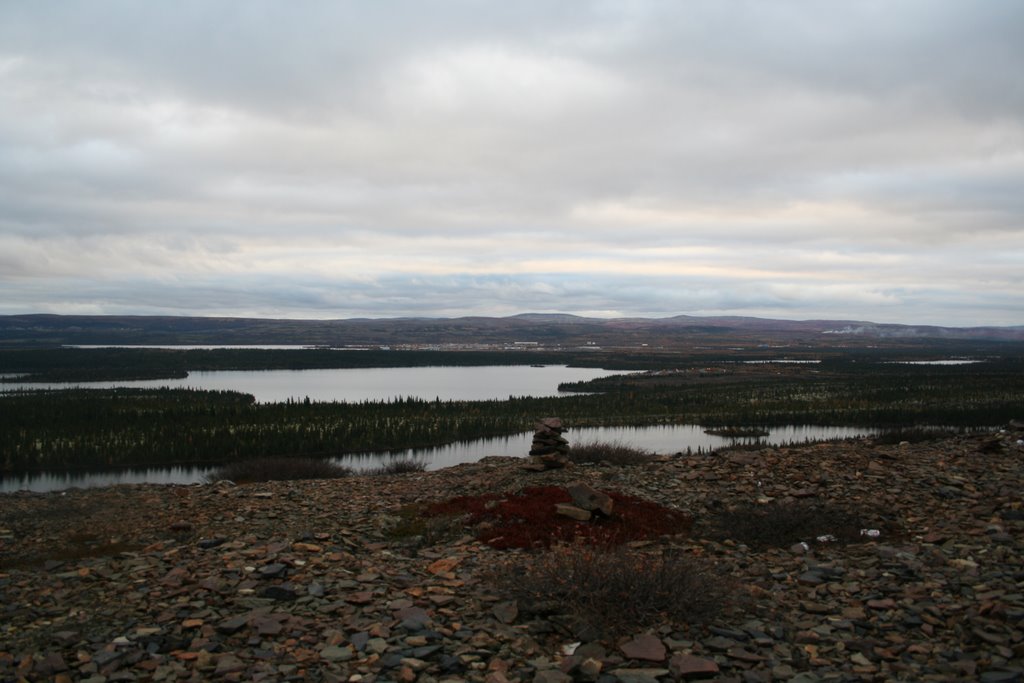
Kawawachikamach
Oh man. Still defrosting from this trip to the Naskapi Nation. Kamil(l)e had been staying with me a few days, so I'd spent minimal time preparing for the trip. Sunday morning we got up at 4:30, I tossed her in a cab to the airport an hour later, shoveled some clothes into a suitcase, then tossed myself into a cab at 6:30 and was on a train headed for montreal by 7:30. The following morning I met Rabih, David and Balgovind at the terminal as we waited for our Air Inuit flight to depart at 7am. We flew straight north, with a brief stopover at Quebec City. As we approached Schefferville, we flew over long stretches of yellow lichen-coated land, spiky little green and yellow trees divided by hundreds of little lakes and rivers. I had expected a more barren landscape, but the aerial view was stunning.
We landed around 10:30am and headed straight for the McGill Research Station, where we dropped off our stuff and became acquainted with the two very large and friendly dogs. An awesome little house--very co-op-y, full of pictures and mementos from students in the 70s and 80s. There used to be a huge iron mining operation in the area, and McGill conducted some sort of geological surveying at the time. But the mine was shut down in 1981-82, when it was declared unprofitable, and Schefferville effectively became a ghost town. Most of the white people left and money stopped flowing into the area. The research station has languished since then and feels partially stuck in the past.
From there we headed down the road to Kawawachikamach, to the Naskapi's band headquarters, where there were some network issues to resolve. Rabih and David installed a squid cache, got it up and running, and then we wandered back over to Schefferville for lunch at Bla Bla's. Everyone spoke French and/or Naskapi.
The evening wound down with a wonderful meal cooked up by Oksana, a history/science teacher at one of the two local schools who also maintains the research station and hosts random passers-through like us. The food situation worked out very well because Baugovin and David were also vegetarian. I had been worried about food (note PR's comment, "What will you eat out there, don't they just eat blubber??") and it was nice to have power in numbers with those guys. After dinner Rabih and David headed out with the spectrum analyzer to look for interference they thought was disrupting the satellite signal.
The following morning, up again at 5:30, the four of us and Barry, the Naskapi computer tech, drove out to Menihek, a tiny little settlement by a dam. HydroQuebec wanted internet and voip installed, and we were there to relocate a dish that had been put up on a previous trip (in June?). It was cold and extremely windy--I was wearing two pairs of pants, two shirts, two sweaters, two thick jackets and I was STILL freezing. Plus I looked pretty awesome staggering around like a giant puffball with wires hanging out of all my pockets. Headphones around my neck, a microphone in one pocket, recorder in another, camera dangling in front of me, notepad sticking out of another pocket. Ridiculous.
One day of hanging out on top of the Menihek dam, with the wind whipping unimpeded across the water, was plenty to wear everybody out. I took a break from watching Rabih and David in the afternoon and went for a walk. I followed the train tracks and watched the sun set across the water. Light rain fell intermittently, and rainbows popped up everywhere. We were staying with the hydro workers in a trailer-ish dorm, and we spent the evening sitting in the tiny dorm lounge, drinking and talking politics, religion, everything into the wee hours. It was very freshman-year. The following morning we woke up early and headed out for pre-dawn fishing at Balgovind's prodding. It was cold and we didn't catch anything, but casting the line out into the water and yanking it around so no fish would dream of biting was quite enjoyable.
Then it was time for breafast. I did a couple more radio interviews and B and I drove back to Schefferville.
I announced that the only disappointment of the trip was that I'd wanted to see a bear, so B and I drove around looking for some. We hadn't seen any in the forest as we drove back, so we swung over past the trash dump to see if we could spot one. No luck. But the osprey were out in full force; We saw several nests perched on the power line poles. We saw one osprey challenge another one that was sitting in a nest, and at one point the seated osprey took to the air and they chased each other, getting into an aggressive stand-off mid-air.
Back in town Ba;govind and Melissa, a Naskapi who also runs the computer center, and I went for lunch. B wanted me to try poutine, a Quebec specialty that consists of french fries smothered in gravy and cottage cheese. (or some sort of curdled cheese. or some white squishy kernels that we were told was cheese.)
Life in Kawawachikamach and Schefferville seems pretty rugged. There are fewer than 1,000 Naskapi out there and, even though it's beautiful and a good hunting area, it's so incredibly remote that flying is tremendously expensive because it's so hard to transport fuel up there. My plane ticket I think cost $1900 Canadian. There's a train that runs up twice a week, on Mondays and Thursdays. If you want to order Chinese food, you call up the restaurant in Kuujjuaq, a slightly larger town further to the north, and they cook it up and put it on the train, and you get it a day or two later. For a special occassion the Naskapi sometimes order KFC from the south and it arrives on the train within a couple days.
Wednesday afternoon I boarded my flight back and that was that. I sat next to a geologist who spoke minimal English, and he humored me as I struggled through a conversation in French. He had spent his life repopulating the rivers up way, way north, at Kuujjuaq and Nunavit. He flew up for a month every year, spent time with the Inuit, and seeded the streams with char. I mentioned to him that the Naskapi had noticed that climate changes were changing the migration patterns of the caribou, which was problematic because their whole culture and lifestyle revolves around hunting caribou. He looked unimpressed and said that the Inuit up north were experiencing the same changes to the migratory circle of the caribou. But the Inuit had set up a GPS tracking system and could easily look up where the caribou were heading. Right. Of course they do, what was I thinking?
Friday, September 29, 2006
love, of all things (and music and landscapes)
self-indulgence ahead! It is sometimes difficult to draw the line between normal observations on life and the icky stuff of confessional prose. Toeing that line once again is this post on loving music and landscapes, effectively several paragraphs of metaphysical cotton candy.
Anyway, this began because a friend of mine said she found landscapes and music much easier to love than people, possibly because one can never completely possess either of them.
1. My first reaction was to think about what it means to love music/landscapes. My relationship with music I'm pretty clear on, the idea of loving a landscape had never occurred to me. And now, writing this, I wonder instead about this business of possessing another person. I think she actually used the word "own" but that word has strong overtones and I think is best left to the domains of consumerism and pets. I'd like to think that possession is an outdated concept pre-dating even our cavepeople days when you, the male cave dweller, kept your mate safely stowed away from other predatory males. So perhaps we're to some degree programmed to feel possessive about our mates, and maybe possession is an emotion that helps keep humans pair-bonded. (obviously pair-bonding either conferred survival benefit or was a secondary effect of some other habit that kept our hides attached to our bodies. No time for this dull topic here.) Humans are just such squirmy things that 'possession' in love is hard for me to conceptualize. Is there subservience involved? Accountability? How much control is inherent in possession? Disturbing territory.
But maybe that's just me.
2.How do you deeply love a landscape? By which I mean a living landscape, not a painting. What I like about them is that, counterintuitively, it’s not perspective that changes how you take it in—you can walk around it all you want, but that won’t make you fall in or out of love with what you see. It’s somehow a greater composite that immediately grabs your attention. But, to me, the moments of visual arrest pale in comparison to the most powerful moments of solitary engagement. Feeling the wind on one's face while standing on a sand dune. Or sitting on a rock and dangling one's feet in clear, shallow water. I guess I wonder how it can be love; to me a landscape is too ephemeral an experience to be a candidate for love. Can you love a landscape and not love a place? I suppose I'm not convinced that this experience is more than pleasure.
3. Music to me is rarely about emotion. Or, rather, I resent that music is quite often about emotion. When it is, listening becomes a form of torture, and the associations can end up so over-powering that the music itself becomes a secondary component of the listening experience. Except for Arvo Part’s Tabula Rasa, which in my opinion is as pure as emotion gets. (and why I almost never listen to it.)
I guess what I’m saying is there’s a point where deriving pleasure in music for music’s sake is overrun by the scenes/memories/possibilities that lyrics and chord progressions trigger, and I find it hard to lose myself in music the way that you can almost lose yourself in fiction. And this is why I love John Cage. I love that he tried to be about music in its least emotionally clogged form. Music to create delight. Every musician/composer shouldn’t be Cage, but Cage at least created one end of a spectrum on which we can consciously choose to slide as we gauge our emotional investment in music.
[side note: the biggest problem I have with music is that it’ll trigger some pleasurable reaction and I’ll forget to wonder whether it's anything I actually like. And then some day I’ll listen again, realize it was terrible, and get upset at myself for being slow to notice. It’s hard work to consciously listen, but it’s like eating canned soup rather than homemade. Still good, but ultimately eh.]
[I’ve also been eating a lot of canned (albeit organic) soups lately. So spinstery! Ick.]
More on the part of loving a landscape once I've got it figured out. It's not intuitive to me.
Tuesday, September 19, 2006
malddebokkwah syndrome
Scrambled thoughts ahead...
Reviewing my notes from an interview yesterday, I tried to decipher what I meant to type when I pounded out 'malddebokkwah syndrome'. I'm guessing it's some French term. Mal de boquois? Mal de bas quoi? Here's another French ambiguity. Let's say you're at a restaurant in France, how would you order fried apple?
Other things gleaned from a day of web browsing and sitting in long meetings: Tinnitis is exaccerbated by caffeine, regardless of how the tinnitis came about. So if one's ears are ringing from loud music, don't drink coffee. I guess it increases blood flow to the ears, causing blood vessels to constrict and... that's where my knowledge of ear function breaks down. Oh the senses. Ears do so much more than just hear things. I'm kind of surprised now that balance is not considered a sixth sense. The ability to determine uprightness given all these confusing stimuli like standing on squishy or uneven surfaces is sort of remarkable. Bending over doesn't make us topple. This should be surprising! All of this is maintained by the vestibular system, which consists basically of the inner ears and some piping. And since a damaged inner ear doesn't necessarily impact conventional hearing, I think it deserves its own honorary sense number.
To follow up on recent thoughts on how we adapt to new roles, here's Don DeLillo on executives playing at being executives:
“There’s a self-conscious space, a sense of formal play that is a sort of arrested panic, and maybe you show it in a forced gesture or a ritual clearing of the throat. Something out of childhood whistles through this space, a sense of games and half-made selves, but it’s not that you’re pretending to be someone else. You’re pretending to be exactly who you are. That’s the curious thing.”
I thought of this yesterday as I sat in a “state of the institute” meeting and several document manager-types gave speeches that were straight out of Dilbert. Except that there was no farce! How can that be? For contrast, when Spectrum staffers gave presentations, they wore tiaras and sashes. I was telling someone the other day about how I felt I was playing at being an adult by dressing too nicely. At what point does play cease to be play and just becomes reality? I am an adult, so in theory I can only excel at playing at being an adult. Playing at being something is the product of stereotype, which then legitimizes and propogates the stereotype itself. Children play at being children, too--for example, baby voice phenomena well past toddlerhood--but not to the exclusion of all other zany games. So is the antedote to becoming your worst nightmare (in this case a mid-level corporate paper shuffler) to play at being other things, too? Children don't stay children forever, eventually the teenager game wins out, and then the college kid game, and so on.
So, well beyond the world of College Self, I empathize with DeLillo's hypothesized panicking executive. We've forgotten how to pretend to be anything else. At this point, is it even possible to revisit a former game? If I walk home to my apartment on the prosaic upper west side thinking I'm a squirrel detective about to snuff out evil forces, will that make me more real? Whatever malddebokkwah syndrome is, this hall-of-mirrors tail-chasing makes a good candidate.
oh yeah, I forgot to mention this marks the rebirth of this blog.
Saturday, December 24, 2005
trying not to think about christmas
as day 7 of struggling through my profile writing assignment comes to a conclusion, it occurs to me that there's a reason most journalists don't write about math. Mountains of Pi being the obvious exception, there's just no easy way to make it accessible, let alone understandable, without cute-ifying it.
it's interesting to me that mathematics has become such a rarefied field, and that applied mathematicians are viewed as the bastard stepchildren of the true theorist types. before he got his act together, gauss spent his days trying to measure the curvature of the earth by surveying as much as he could. some other guy - i'm blanking here - who came up with something electrical that was both useful and elegant was originally totally absorbed by the twitching of frog legs. and it took until the last twenty years or so for mathematical biology in its modern sense to gain true cultural traction.
maybe that's not so interesting. i wish we had a xmas tree this year, that would have been nice.
listened to some messiaen today. the concentration camp cd - not sold yet. now moving on to the birdsong-inspired trilogy... so far not hearing so much the sparrows and the robins as a sequence of single, mildly dissonant chords.
Friday, December 16, 2005
uhaul life
i love how this blog randomly decides the time stamp of my posts. ah, so that's what i was doing at 3:72 a.m.! i'd forgotten.
so, i moved today. i woke up miserably hungover to my phone ringing. it was will calling to figure out if he should come over. clock said 9:30. brain said: ____. clock said 9:31. brain said: OH HELL! HANDBASKETS! HOCKEY STICKS! i was supposed to be up at 6. my uhaul reservation was for 9. i hadn't packed a darn thing, and all i wanted was to obliviate in the fetal position in the bathtub.
so i throw my stuff in boxes and myself on the subway, and i retrieve the van. new york driving: lanes and traffic lights are mere suggestions to be considered and then, perhaps, dismissed. of course three cars fit side by side in a lane. run a red light, sure, why not! honk if you feel an itch. honk if you see a cute dog. and park wherever - you won't find a spot and they'll ticket you no matter what. mine was for $115.
so we move boxes and furniture parts and it all goes relatively smoothly. until will takes off and i drive the van back down to chelsea. halfway there it occurs to me: oh, i don't have my wallet. oh, i don't have my credit cards. or my drivers license. or my jacket. in fact, with $1 in my pocket and dressed in a shirt and jeans, i have no way to get back uptown. and it's winter. so, one very cold sojourn at the uhaul office later, i get ahold of andrew who takes a cab from work, picks me up, gives me money and sends me off to 96th. thank god for friends. really. and the uhaul people were great - much love. i on the other hand was a disaster.
and this was the shortened version of the saga! omitted dramatic elements: the threat of the transit strike. the happy traffic cops. the happy traffic cop who came up and tapped on my window as i sat at the red light and pondered my licenseless driving. and as i rolled down the window, i wondered in the pit of my stomach what on earth i could have done wrong while idling at a red light. but all he wanted to say was, "why don't you smile? things can't be that bad!" weird. how did he know. do people normally strike up conversations with mopey girls driving uhauls?
oh oh oh! fun short movie idea. guy gets kicked out of his apt and moves into an elevator. has a lamp, a nice little chair and desk, some bookshelves. even leaves room for one person to ride up and down. somehow sleeps on a plank that's leaned diagonally across, kind of like sleeping on an airplane. he snipes at people who come home late and drunk. he leads a generally good and cozy life. um, i guess some dramatic arc is lacking, but this was what occurred to me as i and my things filled an elevator and all of a sudden the idea of paying no rent and having all that upward mobility was quite appealing.
Monday, December 12, 2005
the old guard
westbrook pegler should not be forgotten. while his Scopes coverage was uninspiring, he's penned some killer phrases. Memorable Peglerisms: the first is from his days as a sports writer, when he wrote of the fur-clad Yale fans who "rose as one raccoon"; the second is his characterization of the the '20s as "The Era of Wonderful Nonsense".
oh man - "the Booboisie" - Mencken's word for the ignorant middle class. I wonder if i'm boobois.
oh man - "the Booboisie" - Mencken's word for the ignorant middle class. I wonder if i'm boobois.
Tuesday, December 06, 2005
ethnography for dummies
yet another day of being-in-jschool-is-so-humiliating -- sat and stared at an ATM in Lerner for two hours. aahhh!!! courtesy of prof. sudhir "blind date" venkatesh, also known as prof. sudhir "how does it feel to be black and poor" venkatesh. results: a lot of North Face is being worn around the ATMs at Columbia. conclusion: those who wear North Face are more likely to withdraw money from ATMs, or those who withdraw are more likely to buy North Face than those who don't. AHA! Also, none of the bathrooms have soap.
main info gleaned from today: species-area curve controversy. Developed by amateur ecologist who just happened to be reading over some data in a book one day. But he seemed pretty interesting because he didn't go to grad school or anything but just read a lot and then submitted a collection of publications in lieu of a dissertation.
oh, and lisa fauci's leech animations are pretty crazy.
good good link - i'm sure this will come in useful: http://www.realclimate.org
Friday, December 02, 2005
stimuli
one evening of champagne and scones later, the following observations have been made:
1. a kentucky derby field trip is to be scheduled for may.
2. new research project, Brandon's idea: find a way to model how long it takes for X quantity of liquid to generate bathroom-seeking urges. This could then allow people who have difficulties waking to alarms to time their liquid consumption, or invest in IVs, so they wake up out of the need to pee. (wouldn't this potentially lead to a whole lot of bed-wetting?)
3. funny story on ipods and WaPo lameness:
http://www.washingtoncitypaper.com/media/2005/media1202.html
excellent words -- bathetic ( = maudlin, another good one). and vulcanologist, it's so star trek.
also, to note: Austrian fMRI study linked caffeine consumption to increased activity in short-term memory sections of the brain - frontal lobe (working memory) and anterior cingulum (attention).
find that NYT article from around Thanksgiving on college kids trading prescription stimulants to improve work performance. nothing new there, but maybe some inspiration.
yesterday's NYT story on the northern atlantic oscillation slowing/cooling via climate change (is it the same as the conveyor belt shutdown fear?) and making europe colder as a result.
Thursday, December 01, 2005
scopey thoughts
"As a case it is not as much a legal landmark as much as a social landmark. It was a clash between traditionalism and its values and modernism and its values," said Douglas Linder of the University of Missouri-Kansas City law school, who teaches a seminar on famous trials. "It remains an issue. Darwinism and evolution challenge the notion that we are special as a species."
(source:CNN)
it is TIME for a movement in support of underused punctuation. i'm goddamn mad at the dominance of ... over the {s, >s and \s of language.
(source:CNN)
it is TIME for a movement in support of underused punctuation. i'm goddamn mad at the dominance of ... over the {s, >s and \s of language.
Wednesday, November 30, 2005
maybe this wasn't such a lame idea
for the story idea archives -- the antibiotic-resistant strains of tuberculosis. some guy named goldfarb who's working on it in russian prisons. guy at uwashington profiled on the berkeley evolution museum site. tomasz.
of monkeys and zebrafish
the V&R theory proposes that population-level brain lateralization asymmetries arose because the asymmetry conferred an evolutionary advantage on the group. that is, it paid to have everybody exhibit the same brain biases. the main evidence was in the shoaling of fish, which had a better chance of escaping prey when they all swam together and had the instinctual response of turning the same direction. this is counterbalanced by the prey then figuring out that they should attack on the other side, which conferred some advantage to the outliers in the group, those who swam left when everyone else swam right. then there was evidence that the fish could change the direction of their lateralization, and that some species cycle from left-brain to right-brain and back in their flight response bias.
so what does this tell us about humans/primates/any other animal? that lateralization may have occurred back when we were all fish, or earlier? but then what about the switching? why right in the first place? is it consistent across species?
ooh - it would be fun to write about finch songs. plus ten thousand and three people are studying birdsong. now i see why... it brings together lateralization patterns, learning, communication modes, sound, evolution -> hell yeah.
Monday, November 28, 2005
galapagos, wherefore art thine standards?
excerpts from the cinematic underground's promo card:
Scene III. My Dear Self
Wherein we find, astonishingly, our agonist - driving his Self home.
...
Scene IX. The Face of the Girl [Like Glass]
In which He meets Her at a park and sees hope.
oh sad! in later scenes the Airport beckons him and, alas and lo, a decision is reached.
~
this could be interesting -- from jeffrey hutsler's web page -- music cognition vs. language cognition paper. was expected to be published in cognition; a cursory search didn't turn it up, maybe it's elsewhere? the blurb was from 2003, so don't know what happened.
more links for the frozen brain
apparently today's latte rewired me for happiness, not productivity. icelandic music links to be explored:
http://www.dotshop.se/ds/release.php?code=12TO08CD&rand=243226865
http://www.tonlist.com/ViewAlbum.aspx?AlbumID=5579
http://www.mugison.com/Mugison/Music/albums/
defrosting
about that book idea: so i think the antarctic barber - or pastry chef, whoever - story will have to wait until i'm settled, famous, have an agent, and can do the whole book project in a month. because post-iceland i've decided that visual homogeneity aka complete sensory channeling into eery white and eery blue just won't work for an entire year. i mean, wouldn't that burn something weird onto your retina, like the way screensavers used to save your computer screen from getting shadowy icon tattoos? and what an experience it must be to then leave and see real red, real green for the first time. or maybe the underground world of antarctica is really colorful to compensate, like a psychedelic 60s rennaissance all year all the time. i wonder if there's rampant drug use -- it's not the kind of place where you'd want to get lost on a hallucinogenic whim.
yo. why doesn't anyone sell jakobinarina and/or thorir for cheaper than $40/cd?
http://www.rokk.is/
i'm still simmering in iceland (wait. simmering? iceland? crap.)
yo. why doesn't anyone sell jakobinarina and/or thorir for cheaper than $40/cd?
http://www.rokk.is/
i'm still simmering in iceland (wait. simmering? iceland? crap.)
Saturday, November 19, 2005
gingerly
would apple ginger bread be gross?
how about a banana walnut ginger kablammo bread?
ginger chocolate cake?
how about a banana walnut ginger kablammo bread?
ginger chocolate cake?
ideas of the 7am
how do you study the effects of forgetting on psychological health? want to pursue gazzaniga's idea that we spend so much time forgetting that the impact of memory-enhancing drugs might spur on a whole new set of mental disorders. That we create narratives through selective placement of experiences and events into a storyline that implies the rejection of incompatible memories. (and the related idea that at a certain point the number of incompatibles accumulate to the point of spurring a shift in perception. or understanding.) Well, I don't care so much about the rejected memories as I do about what a person does with what he/she does remember. Is there a link between mental disorder and really great memory? Probably not. What about areas of the brain that are activated when a person experiences confusion --- higher activation in memory areas (hippocampus? ug need to learn brain) as well? (if confusion can serve as proxy for narrative failure)
this whole idea of narrative is too conceptually distant from what you can measure, but it does give a more interesting shape to the musings on the possible impacts of better memory.
other thought - how can you write about emergent social properties from a scientific perspective? effects of caffeine on how people work. doctors working ridiculously long hours. being able to command your mind to pay attention on demand. what has this meant overall in terms of our ability to be productive -- and the pressures it places on others to similarly become superhuman caffeine sinkholes? if some people are relying on caffeine to raise their productivity levels, presumably there is some social pressure to also push yourself further and buy into the stimulus game. obviously this would translate into the cog enhancement debate, but how do you get anything concrete about caffeine and social patterns? look at consumption patterns.
start with studies on caffeine and negative side effects. that study of mice with improved learning and intensified susceptibility to pain.
heaving to action
guilt is a powerful motivator. so i apologize to the lady whose aerodynamic locks suffered my scorn - i'm sorry, i really did like your hair.
may cleanliness always be in vogue!
may cleanliness always be in vogue!
Subscribe to:
Posts (Atom)